Recurring Service Scheduling for Pool Service Companies
Last updated: March 2026
Overview
Most pool service owners started their business to work with pools, not spreadsheets. Yet 62% of pool companies operate with zero or one full-time office employee. That means the owner is the scheduler, the dispatcher, and the route planner — often spending 2-3 hours daily just figuring out who goes where.
The math is brutal. A technician wasting 30-45 minutes daily on inefficient routing loses 5-7 service stops per week. Multiply that across your crew, and you're leaving thousands in revenue on the table every month. Meanwhile, your competitors with optimized routes are servicing the same neighborhoods faster and cheaper.
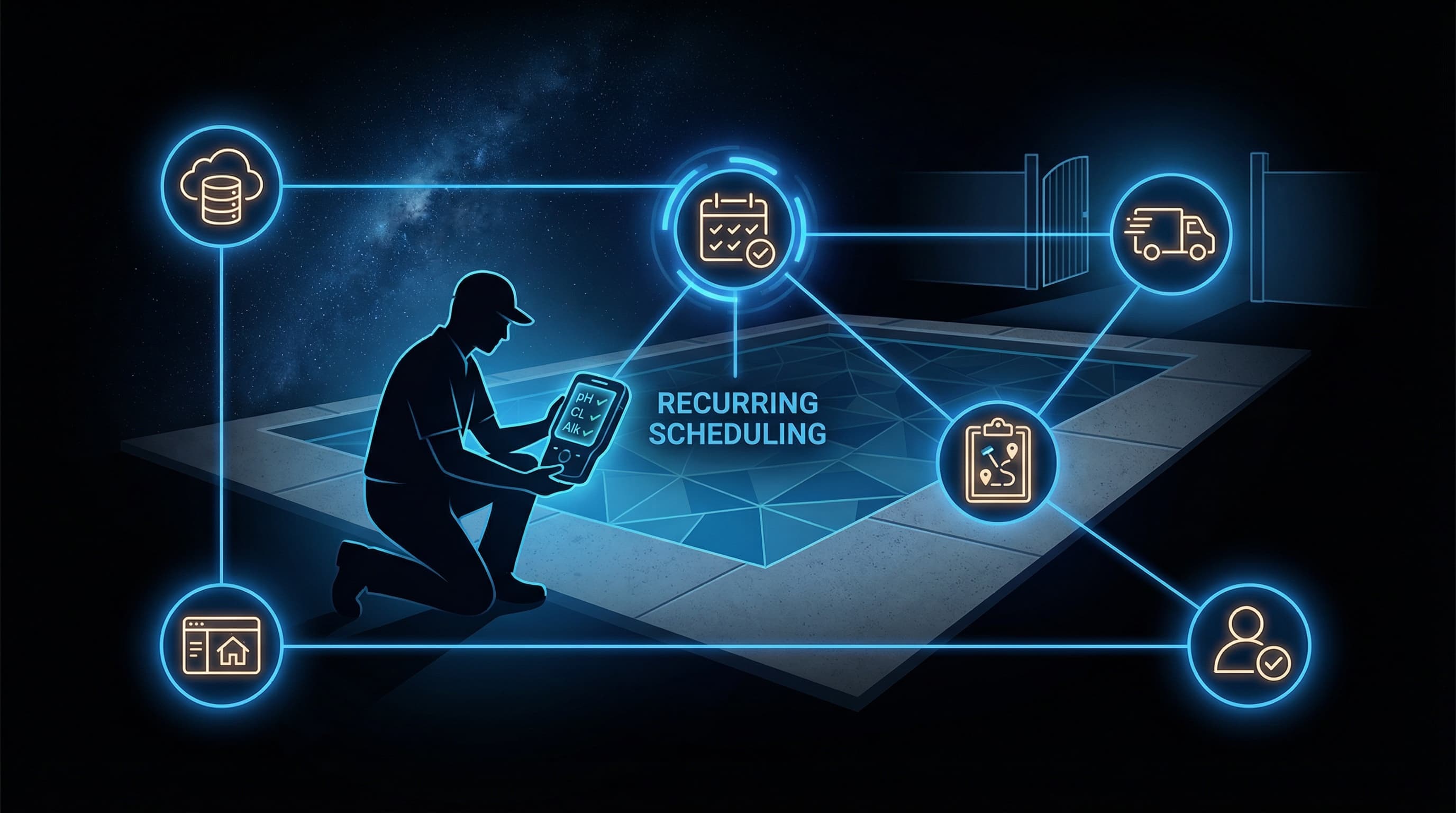
Automated recurring service scheduling solves this by turning your customer database into optimized weekly routes. The system builds route density automatically, groups stops by geography, and adjusts when customers reschedule or gates are locked. You stop playing Tetris with addresses and start running a profitable operation.
The Problem
Manual route planning consumes 2-3 hours daily for pool service owners who lack dedicated office staff. Technicians waste 30-45 minutes daily driving inefficient routes between scattered stops. Profitable routes require 15-20 accounts within a 5-mile radius, but manual scheduling rarely achieves this density. No-access visits — locked gates, customers not home — waste 18 minutes per occurrence and earn zero dollars.
The Solution
Elevasis connects to your practice management software and automatically builds recurring weekly routes based on customer locations and service frequency. The system groups stops to maximize route density, targeting that 15-20 account radius that makes routes profitable. It sends automated service confirmation texts to customers before each visit, reducing no-access visits by 40-60%. When a customer reschedules, the AI reoptimizes the affected route in real time.
How It Works
- 1
Connect your customer database and service history
Elevasis syncs with your existing software to pull customer addresses, service frequencies, and scheduling preferences. Setup takes minutes, not days.
- 2
AI builds optimized recurring routes automatically
The system clusters customers by geography to hit that 15-20 account density sweet spot. Routes minimize windshield time and maximize billable stops.
- 3
Customers receive service confirmation texts
Automated reminders go out before each visit. Customers confirm access or flag issues, preventing wasted trips to locked gates.
- 4
Real-time adjustments handle schedule changes
When a customer reschedules or cancels, the AI reoptimizes that day's route. Your technicians get updated routes without dispatcher intervention.
- 5
Dashboard tracks efficiency gains and route density
See exactly how many more pools you're servicing and how much driving time you've saved. Data proves the ROI within weeks.
Results
Pool service companies see 15-20% efficiency gains within 30 days, reaching 25-30% improvement by 90 days. Teams service 22% more pools daily while reducing driving time by 31%. Automated confirmations cut no-access visits by 40-60%, recovering hours of wasted time each week. A 10-technician crew saves 5-7.5 additional service hours daily — enough capacity to add dozens of new accounts without hiring.
Frequently Asked Questions
The system analyzes your entire customer base, service frequencies, and geographic locations to build the most efficient daily routes. By minimizing drive time between stops and clustering nearby pools together, most companies see a 22% increase in pools serviced per day. Routes recalculate automatically when you add new customers, handle cancellations, or deal with schedule changes.
Most pool service companies reduce total driving time by about 31% after switching to optimized routing. For a typical five-tech operation, that's 8-12 fewer hours on the road each week. The savings compound as you grow — adding new customers to already-optimized routes maintains efficiency instead of creating the patchwork scheduling that happens with manual planning.
The system tracks no-access events and automatically sends the customer a notification requesting updated access instructions. If a pattern emerges — like a customer who's consistently unavailable on Tuesdays — the system suggests rescheduling to a better day. No-access rates typically drop by 40-60% within the first few months as the system learns customer availability patterns.
Yes, the system manages any combination of weekly, biweekly, and monthly service schedules within the same route structure. It ensures each customer's service interval stays consistent while optimizing the route around mixed frequencies. Seasonal adjustments — like switching from weekly summer service to biweekly winter visits — are handled automatically based on rules you set.
The system sends automated service confirmations the day before each visit, including the estimated arrival window. After service completion, customers receive a summary with any notes the tech recorded. This reduces inbound calls asking about scheduling by 50-70% and gives customers confidence their pool is being maintained on schedule.
Most pool service companies are fully transitioned within 10 days. You'll import your customer list and service frequencies, then the system generates optimized routes immediately. Techs typically adapt within the first week since routes are delivered through a simple mobile app. No hardware installation or special equipment is needed beyond a smartphone.
Ready to Automate Your Business?
Show me how automated scheduling works for my pool routes. Book a 15-minute demo.