Violation Notice Workflow for HOA & Property Management
Last updated: March 2026
Overview
Violation enforcement is where community managers face their most uncomfortable reality: inconsistency creates legal liability. According to CAI research, 62% of HOA boards have faced selective enforcement allegations in the past three years. The problem isn't that managers don't care about consistency—it's that manual processes make it nearly impossible to achieve. When you're juggling 10-15 communities and tracking violations in spreadsheets or email threads, follow-ups get missed, documentation gaps appear, and the board becomes vulnerable to claims of unfair treatment.
The math is punishing. Each violation notice takes 20-45 minutes to process manually—drafting the letter, attaching photos, logging the date, setting a reminder, and tracking the response. With 45-55% of violations requiring more than one follow-up notice, a single landscaping infraction can consume 90 minutes of manager time before resolution. Multiply that across your portfolio, and you're looking at 4-8 hours per community per month on violation workflow alone. That's time stolen from resident relationships, vendor coordination, and the strategic work boards actually hired you to do.
This page explains how automated violation notice workflows eliminate the manual bottlenecks that create inconsistency, missed deadlines, and legal exposure. You'll see exactly how the system handles inspection-to-notice delivery, automatic follow-up scheduling, photo documentation, and escalation tracking—with complete audit trails that protect your board when enforcement decisions are challenged.
The Problem
Manual violation tracking creates three compounding problems: it's slow, inconsistent, and poorly documented. The typical community manager spends 4-8 hours per month per community on violation workflow, with each notice requiring 20-45 minutes of manual processing. But speed isn't even the biggest issue—47% of managers cite failure to send timely follow-ups as their top compliance risk, and 32% have no formal tracking beyond spreadsheets and email. When 50% of violations require a second or third notice before resolution, missed follow-ups don't just delay compliance—they expose the board to selective enforcement claims. The cost of a single dispute escalating to legal action ranges from $1,500 to $5,000+, making inconsistent enforcement an expensive liability hiding in your workflow.
The Solution
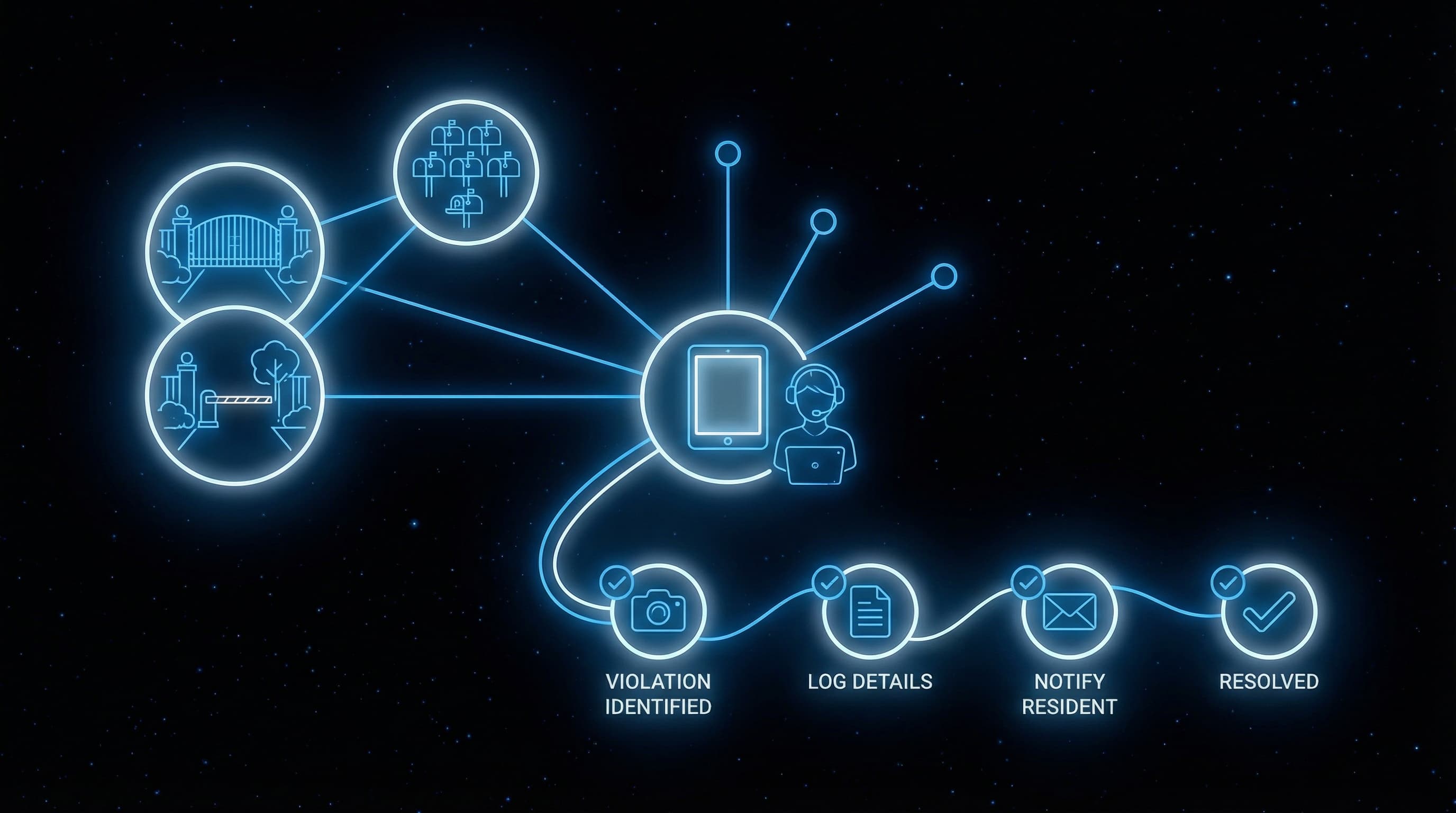
Elevasis automates the entire violation notice lifecycle—from initial inspection through resolution or board escalation—while maintaining the documentation trail your governing documents require. The system generates notices with attached photo evidence and timestamps, automatically schedules follow-up notices based on your CC&R timelines, and tracks every violation's status across your portfolio in real time. When a violation approaches the threshold for board hearing, the system flags it for escalation with complete case history. This isn't generic template automation—it's workflow orchestration that adapts to each community's specific governing documents while ensuring 100% of violations receive correct follow-up at the right intervals.
How It Works
- 1
Inspection data triggers automated notice generation
When you log a violation during a property inspection—whether from your phone, tablet, or desktop—the system captures the violation type, location, photos, and timestamp. It then generates the appropriate notice letter based on that community's CC&Rs and violation category, with all evidence attached and ready for delivery.
- 2
Notices route through your delivery preferences
The system delivers notices via your configured channels—email, postal mail through integrated print services, or resident portal notification. Every delivery method creates a timestamped record showing when the notice was sent and, where applicable, when it was opened or received.
- 3
Follow-up notices schedule automatically based on cure periods
Based on the violation type and your governing documents' cure periods, the system calendars follow-up notices. If the violation isn't marked resolved within the specified timeframe, the next notice generates and sends automatically—no manual reminder needed, no follow-ups forgotten.
- 4
Resolution documentation closes the loop
When a violation is resolved, the system prompts for confirmation photos and notes, then archives the complete case file. This documentation—initial notice, follow-ups, timestamps, and resolution evidence—becomes part of a searchable history that demonstrates consistent enforcement across all residents.
- 5
Escalation triggers flag cases for board action
When a violation exceeds your escalation threshold (typically after the second or third notice), the system automatically flags it for board review and compiles the complete case packet. The 15-20% of violations that escalate to board hearing arrive with full documentation, reducing hearing prep time and strengthening the board's position.
Results
Community managers using automated violation workflows report 60-70% reduction in time spent on violation processing, with per-notice handling dropping from 30+ minutes to 5-8 minutes. More importantly, 100% of violations receive correct follow-up—eliminating the missed notices that create compliance gaps and selective enforcement claims. Consistent enforcement with photo-attached documentation reduces dispute escalations by 40%, and the complete audit trail cuts dispute rates by 30% when violations are challenged. For a manager with a 10-community portfolio, this translates to 25-40 hours reclaimed monthly.
Violation Automation Results
0%
Processing Time
Faster — 30+ min reduced to 5-8 min
0%
Manager Time Per Community
Monthly reduction in violation admin
0%
Dispute Escalations
Fewer with consistent enforcement docs
0%
Contested Notice Rate
Lower when photo attachment is included
Source: Vendor and Trade Data
Frequently Asked Questions
The system allows custom violation types that map to your specific governing documents. When you encounter a non-standard situation, you can create a custom notice with manual cure periods and follow-up schedules. The automation still handles delivery, tracking, and follow-up—you're just defining the parameters for that specific case.
Absolutely. The automation handles notice generation and tracking, not resident communication. When a homeowner calls to dispute a violation or request an extension, you update the case status and adjust the follow-up schedule accordingly. The system logs your notes and any timeline changes as part of the complete case history.
Each community in your portfolio maintains its own violation workflow configuration based on its CC&Rs. A condo association with 72-hour cure periods operates differently than a single-family HOA with 30-day cure periods. The system applies the correct rules automatically based on which property you're documenting, eliminating the mental overhead of switching between governance requirements.
Initial configuration typically takes 2-3 hours per community to map violation types, cure periods, and escalation thresholds to your governing documents. Most managers complete a 10-community portfolio setup within two weeks while maintaining normal operations. Migrating historical violation data from spreadsheets or other systems adds additional time depending on data quality.
Yes, Elevasis connects with major property management platforms including AppFolio, Buildium, CINC Systems, and TOPS Software. Violation data syncs bidirectionally—inspections logged in your primary system can trigger automated workflows, and resolution status updates flow back to maintain a single source of truth for board reporting.
The system generates a complete case file including the original violation notice with photo evidence, all follow-up notices with delivery timestamps, any extensions or modifications logged by the manager, resolution attempts, and the full communication timeline. This documentation package demonstrates consistent enforcement and proper notice procedures—the two elements most commonly challenged in selective enforcement claims.
Ready to Automate Your Business?
See how automated violation workflows eliminate missed follow-ups and protect your boards from selective enforcement claims. Schedule a demo to walk through the complete inspection-to-resolution workflow with your community's CC&Rs.